
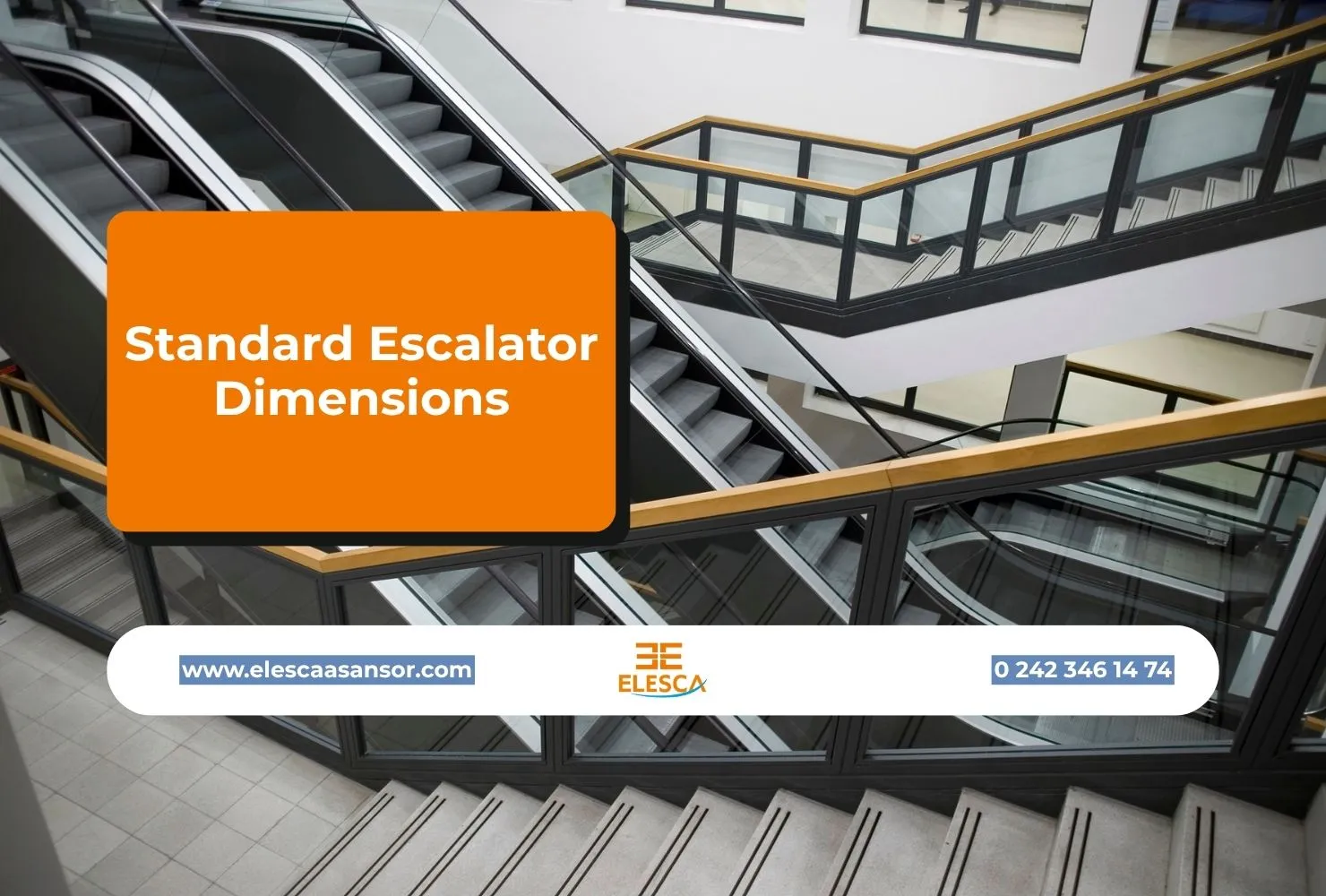
Standard Escalator Dimensions
Standard Escalator Dimensions Complete Guide for Safe and Efficient Escalator Planning
Understanding Standard escalator dimensions is essential for architects, contractors, facility managers, maintenance teams, and property owners who need reliable vertical transportation systems. Escalators are used in shopping malls, airports, metro stations, hotels, hospitals, commercial buildings, and public transportation hubs. Their dimensions directly affect passenger flow, safety, installation space, energy efficiency, and long-term maintenance costs.
At Elesca Elevator & Escalator Systems, we support elevator, moving walk, and escalator systems with high-quality spare parts for domestic and international markets. Based in Antalya, our company supplies essential components such as escalator handrails, pulleys, step rollers, step chains, comb plates, escalator control panels, steps, C return chains, handrail inlet covers, and step skirting. For technical support and product inquiries, you can contact us at +90 242 346 14 74.
What Are Standard Escalator Dimensions?
Standard escalator dimensions refer to the commonly used measurements that define the size, angle, width, height, and layout requirements of an escalator system. These dimensions include step width, inclination angle, rise height, horizontal span, landing length, balustrade height, step depth, and overall installation space.
While dimensions may vary depending on project requirements, building type, passenger capacity, and local regulations, most commercial escalators follow widely accepted engineering standards. The goal is to provide safe, smooth, and efficient movement between floors.
The most common escalator step widths are approximately 600 mm, 800 mm, and 1000 mm. These widths are selected according to expected traffic volume. A narrow escalator may be suitable for low-traffic buildings, while wider models are preferred in malls, metro stations, airports, and public facilities.
Common Standard Escalator Dimensions
The following values are commonly considered when planning escalator systems:
|
Dimension Type |
Common Measurement |
|
Step width |
600 mm, 800 mm, 1000 mm |
|
Step depth |
Approximately 400 mm |
|
Inclination angle |
30° or 35° |
|
Speed |
0.5 m/s, 0.65 m/s, 0.75 m/s |
|
Balustrade height |
Around 900–1000 mm |
|
Landing area |
Varies by project and code |
|
Vertical rise |
Depends on floor-to-floor height |
|
Horizontal length |
Depends on rise and inclination |
These values help determine how much space is needed for installation and how comfortably passengers can use the system. However, every project should be evaluated according to site conditions, technical drawings, traffic analysis, and applicable safety standards.
Why Standard Escalator Dimensions Matter
Choosing the correct Standard escalator dimensions is not only about fitting the equipment into a building. It is also about passenger comfort, operational safety, maintenance access, and system durability.
If the escalator is too narrow for the expected traffic, passenger congestion may occur. If the inclination is too steep for the building type, passengers may feel uncomfortable. If landing areas are too short, crowding may increase near entry and exit points. Poor dimensional planning can also make future maintenance more difficult.
Correct dimensions help ensure:
Safe passenger movement
Efficient traffic flow
Lower wear on mechanical parts
Easier maintenance access
Better compliance with regulations
Longer system lifespan
Improved energy performance
For businesses and public buildings, proper escalator planning can also improve the overall user experience.
Standard Escalator Step Widths
Step width is one of the most important factors in Standard escalator dimensions. It affects passenger capacity, comfort, and building circulation.
600 mm Escalator Step Width
A 600 mm escalator is generally used in low-traffic areas where space is limited. It usually allows one passenger to stand on each step. This option may be suitable for small commercial buildings, private facilities, or areas where passenger volume is moderate.
However, because the available standing space is limited, it is not ideal for high-traffic environments.
800 mm Escalator Step Width
An 800 mm escalator offers more comfort than a 600 mm model and is commonly used in commercial buildings, hotels, offices, and retail spaces. It can accommodate passengers more comfortably and may allow limited side-by-side movement depending on passenger behavior.
This width is often selected when the building needs a balance between space efficiency and passenger capacity.
1000 mm Escalator Step Width
A 1000 mm escalator is widely used in high-traffic locations such as shopping malls, airports, train stations, metro stations, and large public buildings. It offers greater passenger capacity and improved comfort.
This width is often preferred where users may carry luggage, shopping bags, strollers, or other items. It also helps reduce congestion during peak hours.
Standard Escalator Inclination Angles
Inclination angle is another important part of Standard escalator dimensions. The two most common angles are 30 degrees and 35 degrees.
30-Degree Escalator Inclination
A 30-degree escalator provides a smoother and more comfortable ride. It is commonly preferred in public areas, shopping centers, transportation facilities, and locations with heavy passenger traffic.
Because the angle is gentler, a 30-degree escalator requires more horizontal space than a 35-degree escalator. However, it often provides better comfort and accessibility.
35-Degree Escalator Inclination
A 35-degree escalator is more compact and requires less horizontal space. It may be suitable for buildings where installation space is limited.
However, this angle may not be preferred for very high-rise escalator installations or heavy public traffic areas. Project requirements and local safety standards should always be checked before selecting the inclination angle.
Escalator Step Depth and Height
In most escalator systems, step depth is designed to provide secure foot placement and comfortable standing space. A common step depth is around 400 mm. The step height and riser design are engineered to create smooth movement during the transition between flat and inclined sections.
The step is one of the most important parts of the escalator. It must be strong, stable, and compatible with the step chain, step rollers, comb plate, and guiding system. At Elesca Elevator & Escalator Systems, we supply escalator steps and related spare parts for maintenance, repair, and modernization projects.
Standard Escalator Speed
Although speed is not a physical dimension, it is closely related to escalator planning and passenger flow. Common escalator speeds include 0.5 m/s, 0.65 m/s, and 0.75 m/s.
A speed of 0.5 m/s is widely used in commercial and public buildings because it offers a good balance between safety and efficiency. Higher speeds may be used in transportation facilities where passenger movement demand is greater.
Speed selection should consider passenger profile, building type, traffic volume, safety requirements, and local regulations.
How to Calculate Escalator Space Requirements
To estimate the required installation space, designers consider the vertical rise between floors, the inclination angle, upper and lower landing areas, machine space, structural supports, and clearance requirements.
For example, a 30-degree escalator requires a longer horizontal distance than a 35-degree escalator for the same rise height. This means that building layout and available floor area strongly influence escalator selection.
A simplified planning approach includes:
Determine the floor-to-floor height
Choose the required inclination angle
Select the step width based on traffic volume
Calculate the horizontal projection
Add landing space at both ends
Check structural and safety clearances
Review maintenance access requirements
Because every project has unique architectural and technical conditions, professional evaluation is necessary before final selection.
Standard Escalator Landing Dimensions
Landing areas are the flat zones at the top and bottom of the escalator. These areas are critical for safe entry and exit. If landing space is too short, passengers may not have enough time to step on or off safely.
Landing dimensions depend on escalator speed, traffic level, building use, and safety standards. High-traffic locations require larger landing zones to prevent crowding. In shopping malls, airports, and metro stations, landing planning is especially important because people may move in groups or carry bags.
Proper landing design improves passenger safety and reduces operational risk.
Balustrade and Handrail Dimensions
The balustrade is the side structure of the escalator, and the handrail moves along it to support passengers. Handrail height is generally designed around 900–1000 mm from the step nose level, depending on the escalator model and applicable standards.
The escalator handrail must move at a speed synchronized with the steps. A damaged, worn, or poorly tensioned handrail can reduce passenger safety and comfort. Elesca Elevator & Escalator Systems supplies escalator handrails and related components for maintenance and replacement needs.
Handrail inlet covers are also important safety components. They protect the entry points where the handrail returns into the escalator body and help reduce the risk of objects or fingers entering the mechanism.
Comb Plate Dimensions and Function
The comb plate is located at the upper and lower landing points where the moving steps meet the fixed floor plate. Its teeth align with the grooves of the escalator steps, helping passengers transition safely.
Although comb plate dimensions vary depending on escalator brand and model, compatibility is essential. A worn or damaged comb plate can create safety risks and may damage steps. Regular inspection and timely replacement are important for safe operation.
Elesca supplies comb plates for escalator maintenance, repair, and modernization projects.
Step Chain and C Return Chain Compatibility
The step chain is responsible for moving the escalator steps along the track system. Its size, pitch, strength, and compatibility must match the escalator design. When discussing Standard escalator dimensions, the step chain must be considered because it directly affects step movement and alignment.
A worn step chain may cause vibration, noise, uneven movement, and safety problems. C return chains are also important in specific escalator systems, supporting correct return movement and mechanical reliability.
Elesca Elevator & Escalator Systems supplies step chains and C return chains for various escalator applications.
Step Rollers and Pulley Systems
Step rollers guide and support escalator steps as they move through the track system. Their dimensions, material quality, bearing performance, and load capacity affect ride comfort and mechanical durability.
Pulley systems also play an important role in escalator operation. Worn pulleys can cause noise, vibration, belt issues, and operational inefficiency. Properly matched pulleys and rollers help maintain smooth movement and reduce wear on other components.
When replacing rollers or pulleys, technical compatibility with the escalator model is essential.
Escalator Control Panel and Dimensional Planning
The escalator control panel manages electrical operation, safety circuits, speed control, sensors, and system monitoring. While it may not define the visible dimensions of an escalator, it affects installation planning and maintenance access.
A properly installed control panel should be accessible for inspection and service. During modernization projects, upgrading the control panel can improve reliability, safety, and energy efficiency.
Elesca supplies escalator control panels and spare parts for maintenance and modernization needs.
Step Skirting and Safety Clearance
Step skirting is positioned along the sides of the escalator steps. It helps maintain safe side clearance and protects internal components. The gap between the step and skirt panel must be carefully controlled to reduce the risk of trapping objects.
In Standard escalator dimensions, side clearance is a key safety detail. If the clearance is too large, it may create a hazard. If it is too tight, friction and mechanical wear may occur. Regular inspection helps ensure safe operation.
Standard Escalator Dimensions by Building Type
Different buildings require different escalator dimension planning.
Shopping Malls
Shopping malls usually require wider escalators, often 1000 mm step width, because users may carry bags and move in groups. Comfortable landing areas are also important.
Airports
Airports often require wide escalators and moving walks due to luggage traffic. Speed, landing space, and durability are critical.
Metro and Train Stations
Public transportation facilities require high-capacity escalators with strong mechanical components. Step chains, rollers, handrails, and control panels must be suitable for intensive use.
Hotels and Offices
Hotels and offices may use 800 mm or 1000 mm escalators depending on traffic flow and architectural design.
Hospitals
Hospitals require comfortable movement, safety-focused design, and reliable operation. Wider steps and gentle inclination are often preferred.
How Many People Can an Escalator Carry?
Passenger capacity depends on step width, speed, passenger spacing, and usage behavior. Wider escalators and higher speeds can carry more people per hour.
As a general rule, a 1000 mm escalator has greater passenger capacity than an 800 mm or 600 mm escalator. However, real-world capacity may be lower than theoretical capacity because passengers do not always stand continuously on every step.
For high-traffic locations, traffic analysis should be completed before selecting escalator dimensions.
Standard Escalator Dimensions and Modernization
Modernization projects often involve replacing worn components, upgrading safety systems, improving energy efficiency, and adapting older escalators to current requirements.
During modernization, engineers may review:
Step condition
Step chain wear
Roller performance
Comb plate alignment
Handrail condition
Control panel technology
Skirt panel clearance
Pulley wear
Landing safety
Electrical system reliability
Even if the main structure remains the same, replacing critical components can improve performance and extend service life.
Elesca Elevator & Escalator Systems supports modernization projects with high-quality spare parts for escalators, moving walks, and elevator systems.
Frequently Asked Questions About Standard Escalator Dimensions
What is the standard width of an escalator?
The most common escalator step widths are 600 mm, 800 mm, and 1000 mm. The right width depends on passenger traffic, building type, and available installation space.
What is the standard angle of an escalator?
The most common escalator inclination angles are 30 degrees and 35 degrees. A 30-degree angle is more comfortable, while a 35-degree angle requires less horizontal space.
What is the standard speed of an escalator?
Common escalator speeds include 0.5 m/s, 0.65 m/s, and 0.75 m/s. Many commercial buildings use 0.5 m/s for safe and comfortable passenger movement.
What is the standard escalator step depth?
A common escalator step depth is approximately 400 mm. Exact dimensions may vary depending on manufacturer, model, and project requirements.
Which escalator width is best for shopping malls?
For shopping malls, 1000 mm step width is often preferred because it supports higher passenger flow and provides more comfort for users carrying bags.
Are escalator dimensions the same in every country?
No. While many escalators follow similar international design principles, exact requirements may vary depending on local building codes, safety standards, and project specifications.
Choosing the Right Escalator Spare Parts
Selecting the correct escalator spare parts is just as important as choosing the correct dimensions. Components must be compatible with the escalator brand, model, load capacity, and operating environment.
Elesca Elevator & Escalator Systems supplies:
Escalator handrail
Pulley
Step roller
Step chain
Comb plate
Escalator control panel
Step
C return chain
Handrail inlet cover
Step skirting
Using compatible, high-quality spare parts helps reduce downtime, improve safety, and extend the working life of the escalator.
Why Work With Elesca Elevator & Escalator Systems?
Elesca Elevator & Escalator Systems is based in Antalya and provides elevator, moving walk, and escalator spare parts for domestic and international markets. We work with leading industry brands and expert solution partners to deliver reliable products and services.
Our experience in escalator spare parts allows us to support maintenance companies, contractors, facility managers, and technical teams with product supply and solution-oriented service.
Whether you need a step roller, handrail, comb plate, step chain, control panel, or other escalator component, our team can assist with suitable spare part solutions.
For product support and inquiries, contact Elesca Elevator & Escalator Systems at +90 242 346 14 74.
Standard Escalator Dimensions
Correctly planned Standard escalator dimensions improve safety, passenger comfort, traffic flow, and long-term system performance. Step width, inclination angle, landing space, speed, handrail height, and mechanical compatibility must all be considered during design, installation, maintenance, and modernization.
A well-designed escalator is not only a transportation system. It is a critical part of building movement, user experience, and operational efficiency. By combining correct dimensional planning with high-quality spare parts, building owners and maintenance teams can achieve safer and more reliable escalator performance.
Elesca Elevator & Escalator Systems supports escalator systems with dependable spare parts and professional supply solutions for both local and international markets. For escalator handrails, pulleys, step rollers, step chains, comb plates, control panels, steps, C return chains, handrail inlet covers, and step skirting, you can contact Elesca at +90 242 346 14 74.


